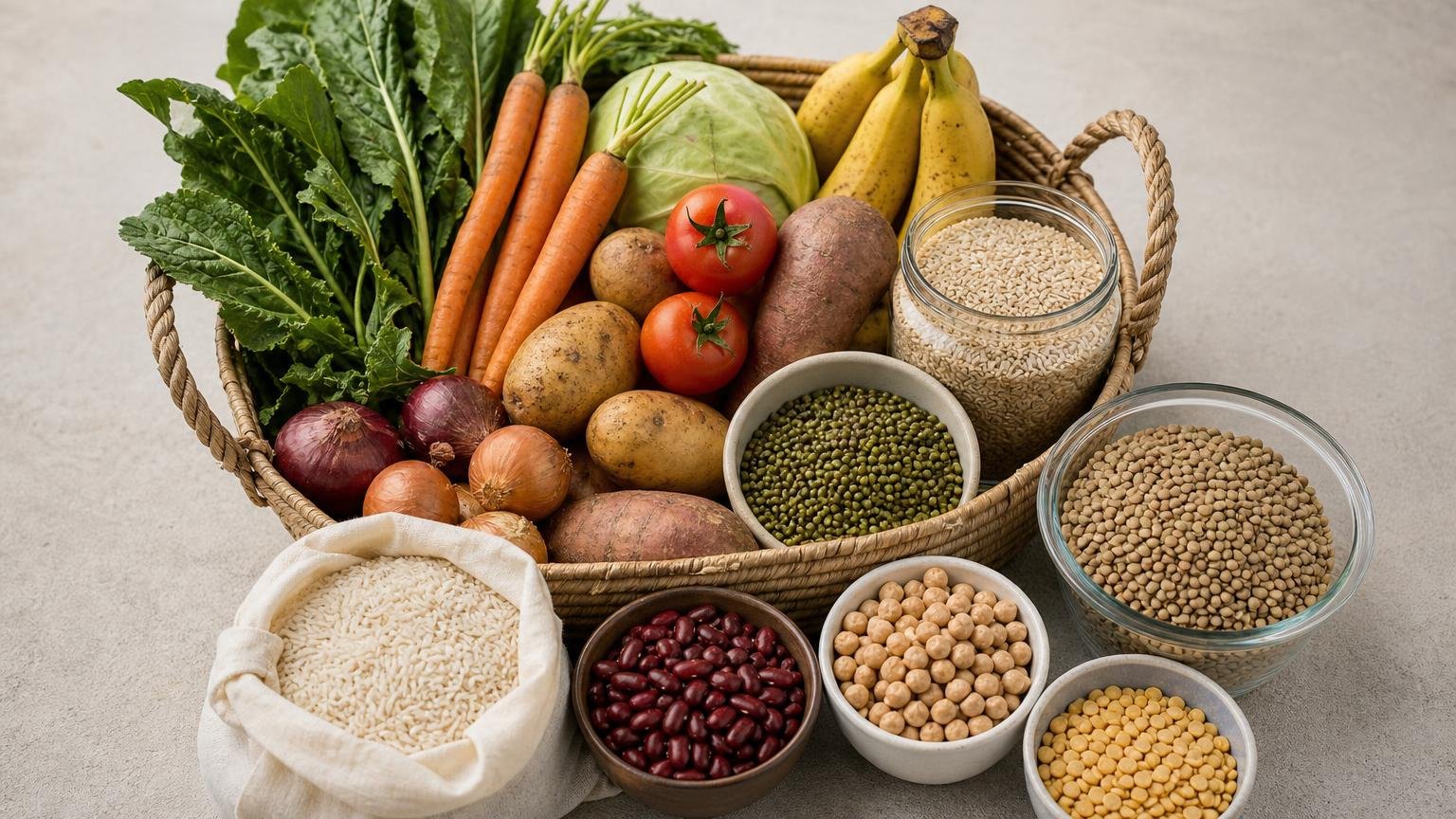
Build a flexible grocery basket around local grains, pulses and produce while accounting for unit prices, preparation costs, storage and food waste.
Key Takeaways
- Build meals around familiar grains or starchy staples, pulses, and locally affordable produce.
- Compare unit prices, but also account for cooking fuel, water, storage and likely food waste.
- Fresh, frozen and canned produce can all fit a healthy diet; check canned products for sodium and added sugars.
- Use pulses regularly or combine them with smaller amounts of meat, poultry or fish when that suits local prices and preferences.
- Buy larger packages only when the food will be used and can be stored safely.
Healthy eating on a budget is not simply a search for the cheapest calories. The practical goal is to combine affordable local staples with enough variety to support nutritional needs—without spending money on food that will spoil, sit unused or cost too much to prepare.
There is no single cheapest healthy shopping list for every country. Prices, cooking fuel, water access, storage, cultural preferences and household needs all change the calculation. Instead of treating particular foods as universal bargains, use the staple-by-staple framework below to compare realistic options in your own market.
Why a healthy diet can be difficult to afford
FAO and its partner UN agencies define the cost of a healthy diet as the minimum spending needed to obtain locally available foods that meet energy and most nutrient requirements. In 2025, that cost averaged 4.28 purchasing power parity dollars per person per day globally, up from 3.44 in 2021 and 2.94 in 2017.
These figures are designed for international comparison. They are not ordinary US dollars and should not be treated as a household grocery allowance. Local prices can differ substantially from national or regional averages.
About 2.69 billion people, or 32.7% of the global population, could not afford a healthy diet in 2025. The estimated share in Africa was 66.6%. Fruits, vegetables and animal-source foods account for large portions of healthy-diet costs globally, while starchy staples generally account for less.
Food prices also reflect far more than farm production. FAO estimates that processing, transport, logistics, wholesale and other post-farmgate activities account for 70–75% of consumer prices. That helps explain why the same type of food may have very different prices in different places. Check the linked FAO source for subsequent updates or revisions.
Start with a flexible nutrition framework
The World Health Organization recommends getting carbohydrates mainly from whole grains, vegetables, fruits and pulses. It also emphasizes dietary variety, minimally processed foods and plant-based protein sources. Fortified staples can be useful where micronutrient deficiencies are common.
For people older than 10, WHO recommends at least 400 grams of fruits and vegetables and 25 grams of naturally occurring fibre per day. Its broader guidance places free sugars below 10% of daily energy, saturated fat below 10% and trans fat below 1%.
These population-level targets are not a personalized prescription. Age, pregnancy, activity, medical needs, cultural practices and local food availability may require a different approach. People managing allergies, deficiencies or health conditions should seek appropriate professional guidance.
A staple-by-staple shopping guide
1. Grains and other starchy staples
Begin with a locally common staple that your household already knows how to prepare. WHO favors whole grains and other less-refined carbohydrate sources where practical, while FAO data show that starchy staples generally contribute less to the total cost of a healthy diet than fruits, vegetables and animal-source foods.
- Compare unit prices: A larger package is not automatically better value. Compare the cost by weight or another consistent unit when that information is available.
- Check the usable quantity: Buy larger amounts only when the household will eat them and can store them safely.
- Consider preparation: A low shelf price may not represent the full household cost if a food requires substantial fuel, water or time.
- Look at fortification: Where fortified staples are available and relevant to local nutrition needs, compare them with unfortified options rather than assuming the lowest package price is the only consideration.
Rice, pasta and dry cereals are among the products the USDA considers shelf-stable when stored properly. Keep bagged or boxed dry goods protected from moisture and pests, using suitable containers when necessary.
2. Pulses: beans, lentils, chickpeas and dried peas
Pulses can form the protein foundation of many budget meals. FAO describes them as generally affordable, nutrient-dense and versatile sources of protein, fibre, vitamins and minerals, with long-established roles across cultures.
That does not mean pulses are always cheaper than eggs, fish, dairy, tofu or meat in every market. Compare the actual options available to you. With dried pulses, include soaking or cooking time, fuel and water in the decision. Canned or otherwise prepared versions may reduce cooking demands, but their price and sodium content should be checked locally.
- Use them regularly: Health Canada recommends including beans, lentils and other legumes in meals several times a week.
- Extend other proteins: Australian guidance recommends combining smaller amounts of meat, poultry or fish with legumes, vegetables and grains.
- Choose a workable format: Dried pulses may suit households with time, water and cooking fuel. Prepared alternatives may fit households where those resources are limited.
- Avoid speculative stockpiling: Buy large amounts only if the household likes the food and has suitable dry storage.
3. Vegetables and fruits: fresh, frozen or canned
Fresh produce is not the only valid option. WHO states that fresh, frozen and canned fruits and vegetables can all be suitable, provided canned products do not contain excessive sodium or added sugars. Health Canada likewise recognizes frozen and canned produce as potentially healthy and economical alternatives when fresh products are out of season.
- Fresh: Consider seasonal or discounted produce when it is affordable and can be used before it spoils.
- Frozen: This can be practical when freezer space is available and the package size matches household use.
- Canned: Compare labels for sodium and added sugars, as well as the unit price.
- Mixed formats: A combination may work better than insisting that all produce be fresh.
The cheapest package is not necessarily the least expensive serving if part of it will be discarded. Plan purchases around meals and snacks, and freeze suitable foods or leftovers when safe and practical.
4. Animal-source foods and other protein choices
Animal-source foods account for a substantial share of healthy-diet costs globally, but that does not justify a universal rule to remove them. Prices, dietary practices and nutritional needs vary widely.
A flexible approach is to compare locally available protein foods and use pulses more often when they offer good value. If a household buys meat, poultry or fish, smaller quantities can be extended with legumes, vegetables and grains. This reduces reliance on a large portion of one higher-cost ingredient without requiring every meal to follow the same pattern.
Make decisions using unit price, the amount that will actually be eaten, storage needs and preparation costs—not assumptions about which protein is always cheapest.
5. Shelf-stable foods
A small reserve of foods that the household regularly uses can reduce waste and make meal planning easier. USDA identifies unopened canned goods, pasta, dry beans and cereals as shelf-stable products. Store them in a cool, clean and dry place, protected from moisture and pests.
Shelf-stable does not mean unchanged forever. Storage time depends on the food, package and conditions. USDA directs consumers to its FoodKeeper resource for food-specific guidance. Bulging, leaking, badly rusted or otherwise damaged cans require separate food-safety attention and should not be treated like intact cans.
How to decide what is genuinely affordable
Use the following questions for each staple rather than relying on a universal list of “cheap foods”:
- What is the unit price? Compare the cost by weight, volume or another consistent measure instead of comparing package prices alone.
- Will the household eat it? An unfamiliar bargain is expensive if it remains unused.
- What will preparation require? Include water, fuel and time where those resources affect the household budget.
- Can it be stored safely? Large packages offer no advantage if moisture, pests, heat or limited refrigeration lead to loss.
- How much is likely to be wasted? A smaller package may cost more per unit but less overall if it prevents spoilage.
- Can another form work? Compare fresh, frozen and canned produce, or dried and prepared pulses, according to local prices and household constraints.
A practical shopping routine
- Plan meals and snacks: Start with foods already on hand, then identify only the missing ingredients.
- Write a list: Organize it around staple foods, pulses or other protein foods, and fruits and vegetables.
- Check sales carefully: A discount is useful only when the product will be used and can be stored.
- Compare brands and shelf positions: Health Canada advises checking generic products and alternatives placed in different parts of the shelf.
- Avoid unnecessary single servings: Individually packaged foods may cost more, although storage and portion needs still matter.
- Substitute when appropriate: Australian guidance supports replacing planned ingredients with affordable seasonal or discounted alternatives.
- Freeze suitable purchases and leftovers: Do this only when freezer space is available and the food can be handled safely.
What This Means
Healthy eating on a budget is best approached as a local comparison problem. Build meals around familiar staple foods, use pulses where they fit, and compare fresh, frozen and canned produce rather than assuming one form always offers better value. If animal-source foods strain the budget, smaller amounts can be combined with legumes, vegetables and grains.
The most economical basket is one that provides variety, suits the household’s needs and can be eaten before it spoils. Unit prices matter, but so do cooking fuel, water, storage, package size and waste. Recheck local prices regularly because no global source can identify the cheapest foods in every market.
Sources
- World Health Organization — Healthy diet fact sheet: https://www.who.int/news-room/fact-sheets/detail/healthy-diet
- FAO and partner UN agencies — 2026 State of Food Security and Nutrition press release: https://www.fao.org/newsroom/detail/un-report--global-hunger-levels-ease-for-third-consecutive-year-as-regional-disparities-persist/
- Health Canada — Healthy eating on a budget: https://www.canada.ca/en/health-canada/services/food-guide/eating-support/meal-planning-grocery-shopping/healthy-eating-budget.html
- Australian Government Eat for Health — Healthy eating on a budget: https://www.eatforhealth.gov.au/eating-well/tips-eating-well/healthy-eating-budget
- Food and Agriculture Organization — World Pulses Day 2026: https://www.fao.org/plant-production-protection/news-and-events/news/news-detail/fao-announces-the-theme-for-world-pulses-day-2026/en
- USDA Food Safety and Inspection Service — Storing dry goods: https://ask.fsis.usda.gov/article/How-do-I-store-dry-goods
